
Gemini 4 Carbon vs Argon vs Hydrogen: Selection Framework
Share this post:
Don’t choose between Gemini 4 Carbon, Argon, and Hydrogen by price tier, and don’t assume the newer model in the lineup strictly dominates the older one. The benchmark and price rankings across this family don’t line up the way the launch order and naming suggest. Hydrogen, the cheapest of the three, scores slightly above Argon, the tier Google itself calls the right choice for most software engineering and knowledge work, on Google’s own published Intelligence Index. If you’re selecting a default model by assuming each tier up costs more because it’s strictly better, that assumption breaks inside this specific family, and the only reliable framework is routing by task type and verifying it against your own evaluation.
The Positioning That Doesn’t Match the Price
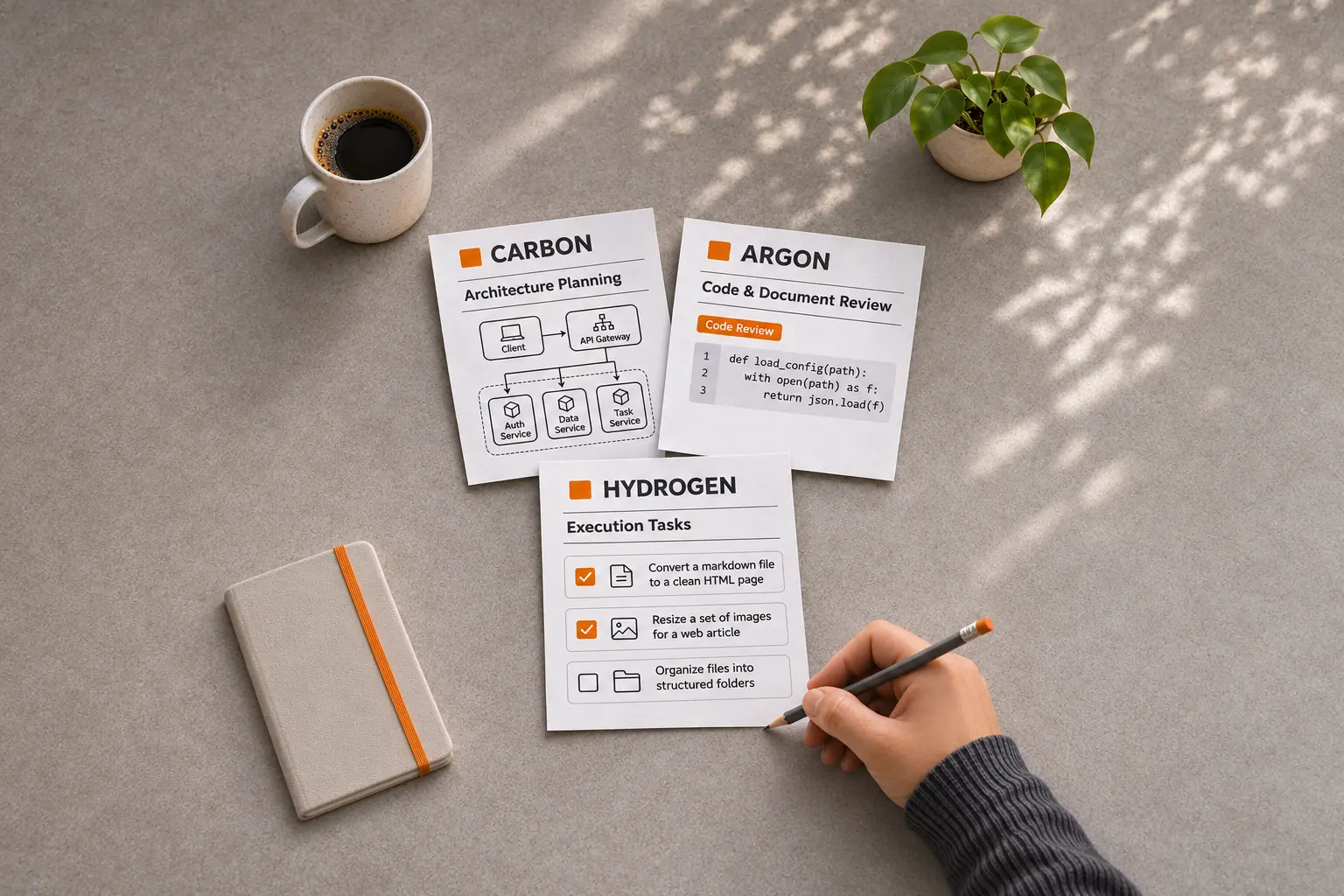
Google’s own framing assigns clear roles: Carbon is built for the hardest tasks, cybersecurity defense and long-running agentic coding that can run for days on a single job. Argon is positioned as the model most teams should default to for everyday software engineering and knowledge work, despite being the oldest of the three and not leading on the metrics Carbon was built to win. Hydrogen is the fast execution tier, meant to work standalone on everyday tasks or as the worker inside a multi-model setup. That hierarchy reads cleanly until you check the actual scores: Hydrogen posted roughly 51 on the Artificial Analysis Intelligence Index at its default setting against Argon’s roughly 50, a small gap but a real inversion, since Hydrogen is priced 25% below Argon’s introductory rate. A team defaulting to Argon purely because it sits in the middle of the family’s positioning, rather than testing Hydrogen directly against the same workload, may be paying more for a result that benchmarks no better.
The Pricing Cliff That Changes the Real Cost Comparison
The introductory window ends, and Carbon and Argon double
Carbon and Argon share the same list price, $2 per million input tokens and $10 per million output, through November 30, 2026. On December 1, that rate doubles to $4 and $20. Hydrogen’s rate, $1.50 and $7.50, has no announced end date. A team piloting Carbon or Argon today at the introductory rate and planning a production rollout needs to model the December pricing before committing an architecture, because a workload that costs a reasonable amount during the pilot window can double in cost overnight with zero change in token volume or usage pattern. This is the kind of deadline that’s easy to miss when a pilot is scoped around “does this work” rather than “what does this cost once the promotional window closes.”
Flat pricing across the full context window
One trait shared across the whole family is worth noting precisely because it’s a non-differentiator: all three models charge the same rate across their entire 1,048,576-token combined input and output window, with no long-context surcharge of the kind other frontier families apply past a fixed threshold. That’s a genuine advantage for long-document and large-codebase workloads regardless of which Gemini 4 tier you pick, so it shouldn’t factor into the choice between Carbon, Argon, and Hydrogen specifically, but it is worth confirming against whatever family you’re migrating away from.
Argon’s Quietly Declining Position
Argon has already been dropped from the consumer-facing Gemini app’s model picker, replaced there by a newer tier introduced after Argon’s launch, while Argon remains available on the API with no deprecation notice published as of this writing. That’s precisely the pattern worth tracking in your own model inventory if production traffic depends on it: a tier that’s been visibly deprioritized in one surface while still sold without restriction in another is a weaker long-term bet than a tier still actively promoted everywhere Google ships it. Treat Argon as a model to actively re-evaluate rather than a safe long-term default, specifically because its own vendor’s product decisions are already signaling where investment is heading next.
Engineering Judgment: The Actual Selection Framework
Route by task type rather than by price tier or launch recency. Reserve Carbon for planning, hard architectural decisions, multi-hour background runs, and security-critical work where its stronger reasoning and verification depth justify the higher per-task cost even after the December price increase. Default to Hydrogen for high-volume execution, worker and subagent roles, and everyday coding tasks, since it benchmarks competitively with Argon at a meaningfully lower price and carries no pending price change. Google’s own Antigravity orchestration pattern reflects this directly: Carbon plans and resolves hard roadblocks, then hands code edits, parallel subagent tasks, and test runs to Hydrogen, coordinated through the Interactions API rather than running every step on the more expensive model. Use Argon only where your own evaluation shows it outperforming both alternatives for a specific task, since neither its current pricing nor its product trajectory gives it a structural advantage anymore.
At SIRAYA, the model selection reviews that hold up across a family like this are the ones that build a small, representative task set and test all three options against it directly, rather than inferring a ranking from price or launch date, because this specific Gemini 4 lineup is a clear, publicly documented example of a vendor’s own naming and pricing hierarchy not matching the actual benchmark results underneath it.