
Claude Fable 5.2 vs Mythos 5.2: Access, Safeguards, Fit
Share this post:
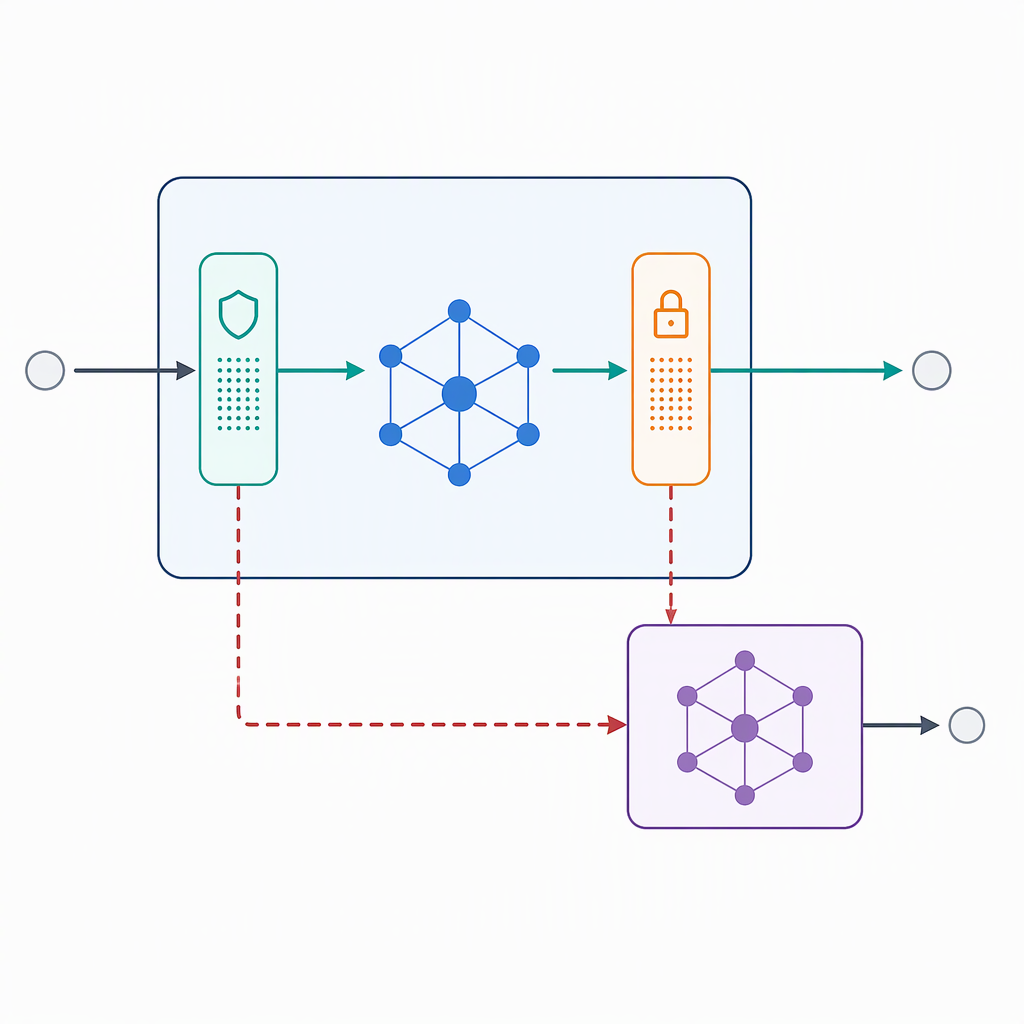
Claude Fable 5.2 and Claude Mythos 5.2 are the same underlying model, so the decision between them is entirely about access and safeguards, not capability. That reframes the engineering question most teams should actually be asking. It isn’t “which one is smarter,” it’s “does our workload touch the cybersecurity or biology work Fable’s safeguards are built to block, and if it does, do we know what happens to those specific requests.” The answer most teams get wrong is assuming a blocked request simply fails. It doesn’t. It gets silently answered by a different, weaker model inside the same API call, and that behavior is exactly the kind of thing a standard evaluation harness never surfaces.
Same Model, Different Safeguard Layer
Anthropic is explicit about this: Fable 5.2 and Mythos 5.2 share one underlying model, and the difference is a layer of safety classifiers. Fable carries cybersecurity and biology safeguards and is open to every paid Claude subscriber and API customer with no access approval required. Mythos has those safeguards lifted and is restricted to organizations vetted through Anthropic’s Cyber Verification Program or Life Sciences Verification Program, with Claude Enterprise customers able to reach Mythos’s vulnerability-scanning capability through Claude Security without separate verification. Both are priced identically at $8 per million input tokens and $40 per million output, a 20% cut from the 5.1 generation, with fast mode doubling that rate for up to 2.5 times faster output. If you’re choosing based on which model performs better, you’re choosing based on the wrong variable, since performance is identical. The choice is entirely about who is allowed to remove the safety limiter.
The Silent Substitution Risk Most Evaluations Miss
A blocked request doesn’t fail, it gets rerouted
When Fable 5.2’s classifiers block a request, cybersecurity queries get answered by Claude Opus 4.8 instead, and biology queries get answered by Claude Opus 5 instead, both materially different, generally less capable models for the task at hand. This happens inside the same API response, with no distinct error code separating “the model you called answered this” from “a different model answered this because the one you called wasn’t allowed to.” For a team whose workload sits anywhere near the cyber or biology boundary, security research, vulnerability triage, bioinformatics analysis, legitimate dual-use-adjacent work that isn’t malicious but looks similar to classifiers trained to catch malicious intent, this is the production risk worth testing for directly. An evaluation set built entirely from clearly benign prompts will never trigger this substitution, and a team that only validates against that kind of eval set will ship an integration that silently degrades in quality for a subset of real production requests, with no visible signal distinguishing a Fable answer from an Opus 4.8 answer inside the response.
The reduction in false positives this generation is real and meaningful. Anthropic reports roughly 55% fewer blocked requests overall compared to Fable 5.1, 60% fewer specifically in cybersecurity and 40% fewer in biology, which suggests the prior generation was overblocking legitimate work at a real rate. That improvement doesn’t eliminate the substitution behavior, it just reduces how often you’ll hit it, which makes it easier to miss in testing precisely because it happens less frequently than before.
Access to Mythos Is Gated by More Than Your Own Compliance Posture
Getting approved through a verification program is only part of the access picture. The tiered access model for this capability class has already been suspended once by external regulatory action, independent of any customer’s individual standing. A U.S. export-control directive forced Anthropic to disable both Fable 5 and Mythos 5 for every customer on June 12, 2026, with access restored on July 1. That’s a three-week window where verified organizations with legitimate, approved use cases lost access entirely, for reasons that had nothing to do with their own compliance history. A production dependency on Mythos specifically inherits that kind of availability risk, geopolitical and regulatory rather than purely technical, on top of the normal vendor outage and deprecation risk any production AI dependency carries. Any team building a security or life-sciences workflow around Mythos needs a documented fallback plan for this specific failure mode, not just a generic vendor-outage runbook.
Engineering Judgment: Workload Fit and Cost Discipline
Anthropic’s own guidance is worth taking seriously rather than treating as modesty: start most coding and knowledge work on Opus 5.5, and move up to Fable or Mythos only for the hardest, genuinely long-running agentic tasks, since Fable costs twice Opus 5.5’s per-token rate and that premium compounds fast across long agent sessions. Early testing has already produced real five-figure bills for ambitious agentic projects run end to end on Fable, which is a useful reminder that a capable model running unsupervised for hours or days is a cost-control problem as much as a capability one. Use the advisor and orchestrator pattern Anthropic built for this tier, letting Fable or Mythos direct cheaper executor models for the bulk of the work rather than running every step on the expensive tier by default. And keep human approval on critical, irreversible actions regardless of how capable the model tests as, since Anthropic’s own team has said reliability remains an open issue for long unsupervised agent runs, which is not a caveat worth ignoring just because it comes from the vendor itself.
At SIRAYA, the production reviews for this model class focus less on benchmark position and more on two concrete questions: does the evaluation set actually exercise the boundary where Fable’s safeguards fire, and does the production fallback plan account for the entire access tier disappearing for reasons outside the customer’s control, because both of those are the failure modes a standard model comparison will never show you.