
Gemini 4 Neon: Architecture for Fast Agentic Workflows
Share this post:
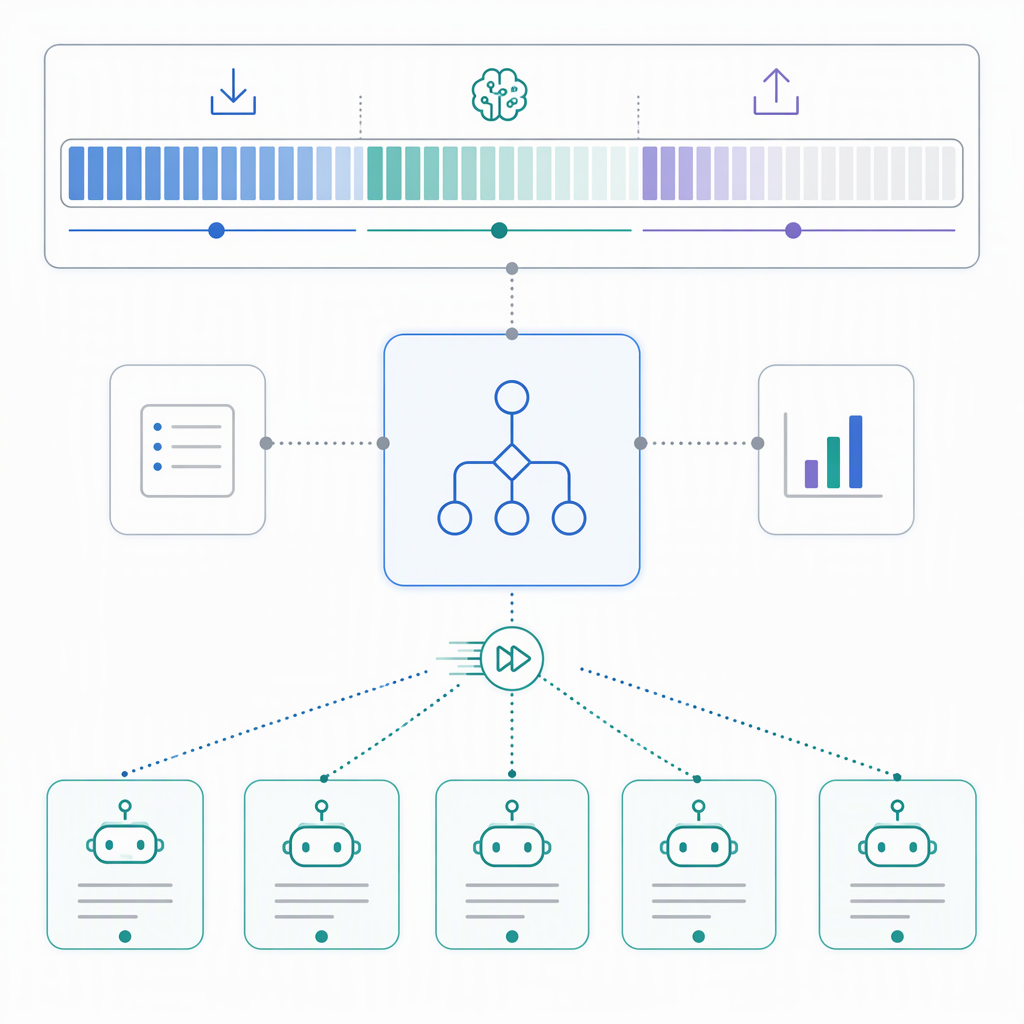
Gemini 4 Neon’s real production value for agentic workflows isn’t where it lands on a benchmark table, it’s the orchestrator-worker pattern Google built the model around, where Neon plans and verifies a task while handing execution off to lighter, faster Hydrogen subagents for the actual work. That architecture only holds up in production if you budget tokens correctly, because Neon’s one million token context is a single shared pool across input, reasoning, and output, not a million tokens of input plus a separate million of output. Treating it like the latter is the fastest way to watch an agentic loop quietly truncate its own final answer.
What Neon Actually Is and Where It Sits
Neon is adapted from Gemini 4 Carbon and occupies a specific middle position in Google’s lineup: Carbon handles the hardest, longest-horizon projects, Hydrogen handles fast everyday execution, and Neon is positioned as the balance between the two, built specifically for complex coding, analytical reasoning, and production-grade enterprise workflows that need frontier-level reasoning delivered quickly and repeatedly. That positioning shows up directly in the pricing: Neon costs $3 per million input tokens and $15 per million output, which sits above Carbon and Argon’s introductory rate and roughly double Hydrogen’s. It supports four thinking levels, low, medium, high as the default, and xhigh, giving teams a dial between response depth and token spend rather than a fixed capability tier.
The Orchestrator-Worker Pattern Google Built the Model Around
How the handoff actually works
Google documents a specific multi-model pattern for Neon rather than leaving it as an afterthought: plan and verify a multi-step software engineering or analytical workflow with Neon, then pass a previous_interaction_id to Hydrogen subagents on the Interactions API for lower-latency worker execution. This is the same orchestrator-worker idea that shows up across the industry in different forms, a capable model directs the plan while cheaper, faster models execute the individual steps, except here it’s built as a first-party, same-family handoff mechanism rather than something you have to stitch together yourself across providers. For a team building a fast agentic workflow, that’s the architectural decision worth adopting early: let Neon own the planning, verification, and judgment calls, and route the repetitive execution steps to Hydrogen rather than keeping every step on the more expensive, heavier model by default.
The Token-Budget Mistake That Breaks the Agentic Loop in Production
900K input leaves 148K for everything else
Here’s the detail that catches teams who assume “1M context” means what it sounds like. Neon’s context window is a unified 1,048,576-token limit shared across input and output tokens on every API surface, and output specifically includes thinking tokens, function calls, and the final response, all counted against the same budget. A request with 900,000 input tokens leaves at most 148,576 tokens for reasoning and output combined, not a full separate output allowance. A single synchronous response is capped at 65,536 output tokens regardless, and reaching further requires explicitly using long-decode mode with a continuation token, which extends output up to the remaining budget rather than giving you another full million tokens for free. The practical failure mode is a low max_output_tokens setting silently cutting off a final answer, because the thinking tokens a reasoning model generates internally count against that same limit before the response ever gets written. If your agentic loop feeds Neon large documents or long conversation histories, budget for this explicitly rather than assuming the headline context figure describes input and output as two separate million-token pools.
Engineering Judgment: What to Verify Before You Adopt It
Treat Google’s own benchmark claims as a starting point to test, not a settled result. At least one of Neon’s headline numbers, its Vals Index score, was still absent from the public leaderboard snapshot at the time independent reviewers checked it, which means the figure Google published hadn’t yet been independently reproduced where anyone outside the company could verify it. Run your own representative tasks against Neon, Hydrogen, and whatever model you’re replacing, and grade the output against a fixed rubric that tracks total billed tokens, retries, and elapsed time, not just whether the response looks good.
There’s also a lifecycle detail worth flagging if you’re already running production traffic on Argon: Neon took Argon’s slot in the consumer-facing Gemini app, and Argon is no longer offered there at all, while it remains available on the API at its introductory rate until the end of November, after which the price doubles, with no deprecation notice published as of this writing. That’s precisely the kind of quiet product repositioning worth tracking in your own model inventory rather than discovering when a bill or an access change catches you by surprise.
At SIRAYA, the teams getting real throughput gains from Gemini 4 Neon are the ones treating it as two decisions rather than one: adopting the orchestrator-worker split deliberately, with Neon’s planning role and Hydrogen’s execution role mapped explicitly to the steps in their own workflow, and separately building a token-budget model that accounts for the shared input-output pool before the first production incident teaches them the hard way that a truncated response wasn’t a model failure, it was a budgeting assumption that never matched how the context window actually works.